Wednesday, September 23, 2015

PROfessionals are PROactive

So far in our personal leadership EMPOWER series we have covered ENDVISION and MUTUAL VICTORY. Today's read talks about the power of being PROACTIVE in your personal leadership journey.

In my career I have observed individuals who seem to have the Midas touch; everything they touch seems to turn gold. They seemingly possess psychic powers that puts them ahead of the curve with their career on a fast track. Even in my own family, my grandmother (with an eighth grade education) was always prepared and not shaken by the twist and turns of life. In the search for their secret, I discovered that there really was no secret; all these individuals possessed the very same stuff I had in me. The common denominator was their proactive lifestyle. I, like many others thought that life was an adventure that just happens and you have to adjust accordingly and that we are all dealt a predetermined hand in life and have to live and react to what is thrown at us. This, for the most part, is not the case. Sure there are things we can’t change, but there is so much more we have control of that it leaves little room to accept mediocrity. Proactive in your personal life and professional life is all about attitude and planning. When these two principles are mastered, life is more predictable and we are prepared for the curve balls. As firefighters we do this as part of our job description. For example, if you pre-plan a target building in your area and a fire happens at that location, you minimize or eliminate catastrophic loss (proactive). However, no pre-plan and figuring things out during the incident can have more negative outcomes (reactive). Being proactive in attitude even with small things primes the pump for handling big things. Being proactive about our physical and behavioral health, finances, professional development and overall personal leadership will make us assets to all we affect.
 
Proactive about physical health keeps us ready to do our physically demanding job. We are industrial athletes, and just like a sports athlete we must make our physical health a top priority. The number one killer of firefighter deaths is cardiac related. This, for the most part can be controlled by diet and exercise. Being proactive helps us live longer and perform longer with less chance of injury or long term health issues.  

Proactive about finances helps reduce stress in all aspects of life and steers us to better decisions. You will never live rich on the average firefighters salary but I know firefighters personally who seem to have mastered making their money work for them instead of working for the money. Taking charge of your finances will not only help you and your family but retirement can be stress free as well. I personally haven’t mastered it as much as I would like but the few I know who mastered 10/10/80 possess a nice financial portfolio. (10=tithe/charity, 10=savings/investments and 80=normal lifestyle/living expenses.) This proactive mastery and discipline of finance not only helps immediately but it can create a cycle of good habits for your children.

Remember my grandmother? The reason I mentioned her eighth grade education is because she always had money and resources. This woman w as not a Wall Street professional and did not possess a college degree in finance. My grandmother applied simple savings and spending principles that kept her out of debt. She owned property and put my mother through private school single-handedly. Proactive principled finances needs application in more cases than education. Your choice, operate proactive financially or reactive financially. Hopefully you are a PRO.  

Proactive about professional development is critical in our job as professional firefighters. Professional development in today's world is more available than ever before. There are a ton of courses, webinars, degrees that are catered to the busy lifestyle we all have today. Proactive professional development not only prepares us for what the future holds but keeps us sharp for today and right now. The dynamics of our industry changes fast these days, with changes in building construction, equipment and technology. Proactive professionals are hungry for the knowledge that will keep them ahead of the curve. Our lives in many cases depend on how knowledgeable we are regarding those changes. Professional development also can help us find ways to be a better person for our professional family and personal family. Professional development is a lifelong commitment and if we approach with this attitude we will be learn the beauty of being content but never satisfied. Content = finding happiness where ever we are. Never satisfied = we know there is always a better me waiting to be discovered. Professional development is like a river moving and giving life; and lack of professional development is like a pond, stagnant and very little life. Choose LIFE.

Proactive Professionals don’t possess the magic Midas touch powers. The power is in all of us and we have to wake up the giant within. Less stress, quality lifestyle and more production lay ahead for the PROactive PROfessional.  Live and fight fires like a PRO; our public deserves it, our profession deserves it, our families deserve it and most important YOU deserve it….


---
Larry Conley is the president and lead instructor of Leadership Development Concepts, LLC. He travels the country to present his popular and compelling program, ZERO TO HERO Personal Leadership (Powered by GLUE). The concept of GLUE (Growing Leaders Using Empowerment) was born in the fire service, where Larry successfully juggles many leadership roles. 

Larry’s initiative and creativity are put to work in his roles as: Captain of the St. Louis Fire Department (Truck 13C); President of the Parkway Gardens Neighborhood Improvement Association; Chief Instructor for the Highlander Fire Academy St. Louis Community College at Forest Park; Director at Large for the ISFSI (International Association of Fire Service Instructors); President of the Supervisory Committee and Board Member St. Louis Firefighters Credit Union; and Co-Chair of the Fire Education Subcommittee Missouri Community College Association.

 

Monday, August 31, 2015

Human Relations Model and Motivation

Being a leader in the fire service is a difficult job.  A person who can read another person and recognize their needs and wants is an amazing trait to have in this position.  “People want to feel useful and important and they have the desire to belong and to be recognized as individuals.”  This is the generalized platform for the Human Relations model.  The manager's basic task is to make each worker feel useful and important.  This is sometimes a hard accomplishment but to have a successful organization this is one of the most important things. 
A long time ago, early in my career, I asked a well-respected chief what major I should take if I want to advance in my career.  His advice was, “Go and get your psychology degree, more importantly child psychology.”  He was joking about the child part, (at least I thought) but he had an amazing point.  To excel in our field you have to understand people and more importantly what motivates them. 
“People want to have a sense of belonging and significance while being treated with value and respect. Treat an employee with respect and value, and their individual productivity and quality increases to support the organizational team.”  This is true in almost anything we do.  A happy employee, with knowledge of the overall goal of the organization, is the best asset any organization can ask for.  To end, something I say every day to the people that work for and with me is “Did you smile today”.  I say this for a couple of different reasons, I want them to know I am approachable about anything and I am always there for them.  Second, I just want to remind them that we work in the best career field in the world and they should never have any reason to think otherwise. 

Written by: Robin Nicoson II


Douglas, Ashtyn. "Human Relations Management Theory Basics." Business.com. Gail L. Perry, 27 Sept. 2011. Web. 30 Aug. 2015. <http://www.business.com/management-theory/human-relations-management-theory-basics/>.

Friday, August 21, 2015

Soft Skills Matter: END-VISION

In our previous article we summarized the 7 principles that make up the EMPOWER model:

END-VISION
MUTUAL VICTORY
PROACTIVE
ORGANIZE PRIORITIES
WORKING TOGETHER
EMPATHETIC LISTENING
RECHARGE

This personal leadership model strengthens your soft skills and proves to be a game changer in your fire service career. In this first of 7 articles, we will concentrate on the importance of END-VISION.

"Action without vision is only passing time, vision without action is merely day dreaming, but vision with action can change the world."
- Nelson Mandela
 
All successful accomplishments begin with having the end in mind. Builders know how the structure will look at the end before they even dig the foundation. Travelers know the destination before the journey. The artist knows how the picture will look before the canvas is touched. It's not wise to expect a successful outcome without end-vision. Personal leadership needs a strong direction and a clear vision. I've found the best way to not lose sight, is to develop a personal mission statement to support your end-vision. Once your end-vision is clear, then your personal mission statement will reveal itself, and developing a detailed road map will be needed to keep you on track. 
 
“If one does not know to which port one is sailing, no wind is favorable”.
-Lucius Annaeus Seneca

 
Life has many detours and distractions (its designed that way) but with a healthy end-vision no matter how much you get off course, a strong true north compass will always get things back on the path. This is why it’s critical to not only develop a strong mission statement, but study and follow it constantly. Leaders who master this principle enjoy success at higher levels than those who don’t see the importance. Life also changes as time passes, this is also a reason to study your personal mission statement regularly. Adjustments have to be made to change with the times. It’s important to develop a statement that’s flexible enough to adjust but doesn’t compromise your principles and foundation. For instance, you may be single when you first write your mission statement, but you will need to allow room for adjustments if you get married, have children, etc. You may be a rookie on the job when you write the mission statement, but as you are promoted through the ranks your priorities may need adjustment, though your guiding principles (compass) should not change.

Your mastered end-vision will be the best example for those who you influence; your team members, subordinates, family, community, etc. Teams need leaders with a clear vision of where they are going and a detailed plan on how to arrive. The best outcome would be for all on the team to have clear end-visions of their own. Clear direction for all members will not only create an unstoppable team, but will prepare them for advancement in career choice and quality of life. If you are the catalyst, developing life-long leaders not life-long followers is the best goal. The absolute beauty of personal leadership is not defined by promotions or how many people you’re in charge of. Successful personal leadership is defined about how successful you lead yourself. Some of the best leaders and pillars of organizations are not the people in charge; but the people who are clear about their direction, foundation, beliefs and their end-vision.  Promotions, popularity and recognition as a leader are all icing on the cake, but remember, the icing is only as good as the cake.  SOFT SKILLS MATTER!

---
Larry Conley is the president and lead instructor of Leadership Development Concepts, LLC. He travels the country to present his popular and compelling program, ZERO TO HERO Personal Leadership (Powered by GLUE). The concept of GLUE (Growing Leaders Using Empowerment) was born in the fire service, where Larry successfully juggles many leadership roles.  
 
Larry’s initiative and creativity are put to work in his roles as: Captain of the St. Louis Fire Department (Truck 13C); President of the Parkway Gardens Neighborhood Improvement Association; Chief Instructor for the Highlander Fire Academy St. Louis Community College at Forest Park; Director at Large for the ISFSI (International Association of Fire Service Instructors); President of the Supervisory Committee and Board Member St. Louis Firefighters Credit Union; and Co-Chair of the Fire Education Subcommittee Missouri Community College Association.
#3 - Forcing Inward Opening Doors: Mike Perrone Forcible Entry Training

Tuesday, August 18, 2015

Loss of Situation Awareness


Loss of Situation Awareness

Attributing fireground mistakes to issues beyond human error

By Sidney Dekker
Published Saturday, August 1, 2015 | From the August 2015 Issue of FireRescue
At a founding conference on situation awareness in the mid-1990s, safety veteran Charles Billings wondered aloud whether the use of "situation awareness" was necessary to explain what causes people to see, or miss, or remember seeing something. "It's a construct!" he said in his keynote address. "Constructs cannot cause anything!"
Billings passed away in 2010, and by then the loss of situation awareness (i.e., loss of a construct) had become the favored cause for human performance-related mishaps.
Human Error
Why is it a bad idea to use "loss of situation awareness" when trying to explain human performance difficulties? In short, it is simply a new way of saying human error. Using the explanation of loss of situation awareness to evaluate or explain behavior can have consequences, including the following:
  • It says that you now know more than other people. It is not an explanation at all. Instead, it puts you in the position of retrospective outsider judging people for what they did not see but what you now think they should have seen (things that you know because you know the outcome—because of hindsight).
  • It is based on 17th-century ideas about the workings of consciousness, when people believed that the mind is a mirror of the world. Developments in cognitive science have long since overtaken this idea. We know there is no such thing as a mental vacuum. So if you lose situation awareness, then what replaces it? Sawdust?
  • Because of the seemingly scientific ring to it (as opposed to "human error"), it is now being used by others (media, the judiciary, regulators, employers) to condemn firefighters for their role in incidents. Don't make their case against a colleague of yours easier by judging them in advance for losing something you can only know in hindsight.
Let's look at these three reasons for not using "loss of situation awareness" in more detail.
Hindsight
Hindsight easily slips into our judgment of human performance, even under more modern labels. "Loss of situation awareness" is no more than the difference between what you know now and what other people knew back then. And then you call it their loss.
What this really shows, however, is your ignorance about the situation other people faced. You are not making an effort to go into the tunnel and understand why it made sense for them to look at what they were looking at. That you now know what was important means little, and it explains nothing. In fact, it really interferes with your understanding of why it made sense for people to do what they did.
17th-Century Thinking
"Loss of situation awareness" is actually based on 17th-century ideas about the workings of consciousness. What philosophers and scientists at the time believed was that the mind was like a mirror of the world outside. Knowledge of the world is based on correspondence. What is in the mind, or in awareness, needs to correspond to the world. If it doesn't correspond, then that knowledge is imperfect. And the human mind needs to do more work to make the correspondence perfect.
Such 17th-century ideas have made it possible for today's investigators to claim that they did know what was in the world, and then they can show that the firefighters in question did not. This is a very arrogant position to take, of course. And a meaningless one. You basically say to a firefighter after the fact that you now know the real state of the world (that is, your correspondence was perfect) but that he evidently did not. Situation awareness is a judgment you make. And if that is not perfect, then you call it their "loss of situation awareness."
The biggest problem in this is that you get to decide what is accurate situation awareness. But what is that? The indications from a developing fire that you now know were important? But you only know that with knowledge of outcome, in hindsight. If the firefighters inside of the situation had known the outcome, they too would have considered those indications important. And they would have acted on it, just like you would have. The point is that they did not know the outcome. If they had, they would have done things differently. Your job is not to point out (by whatever labels) that you are now smarter than firefighters were. Your job, if you are an investigator, is to understand what made sense to them at the time (without knowing the outcome!) and to explain it to others.
Developments in cognitive and other sciences have shown the correspondence idea of knowledge to be unsustainable. Here is the really short version: No person in the world is so privileged as to have access to a reality against which all other people's understanding can be proven wrong or inaccurate or somehow "lost." The way each individual looks at the world is determined by where that individual stands. The same is true for all us:
  • Everybody's perspective is unique, determined by the position from which you take it.
  • No two people can be in the exact same position at the same time, so no two perspectives can ever be the same.
  • Nobody's perspective on the world can be reduced to someone else's.
  • Everybody's perspective is subjective.
  • Nobody has an objective perspective, against which other people's subjective perspectives can be compared.
As an investigator, in hindsight and with knowledge of outcome, you might believe that you have something that other people lost. Sure. But your view is subjective and unique (just like those of the people whose performance you are examining) and just as constrained (though by other things) as the next person's. Anything else would assume that you can somehow take a view from nowhere—an objective view that is entirely free from any influencing background, knowledge, or position in the world. There is no such viewpoint. You have to stand somewhere! You have to view things from somewhere. So you might as well try to see them from the point of view of the people whose actions you are trying to understand.
Firefighter Condemnation
Charles Billings' remarks that situation awareness is a construct and that constructs don't cause anything must have gone unheard—or unheeded. "Loss of situation awareness" now "causes" plenty of incidents and accidents in firefighting. This is no longer just a supposed explanatory use of "loss of situation awareness." Situation awareness, in these cases, represents a duty of care, the professional commitment expected of firefighters whose actions can influence the lives of others. When investigators, bosses, prosecutors, or regulators demonstrate a "loss of situation awareness" (which is very easy), it represents an absence of a duty of care, a breach of the relationship of trust with patients, passengers, and colleagues; it represents a failure to live up to a professional commitment; it represents a possibly prosecutable crime.
This takes situation awareness beyond the wildest dreams of those who introduced it to the human factors lexicon. Other people can always show that there was more in the world than there was in the mind, because in hindsight anybody can show that. And they can then call that difference the firefighter's "loss of situation awareness." Just imagine the following exchange that may show up in the legal aftermath of a fire incident:
Counsel: Wouldn't you agree that accurate situation awareness by firefighters like yourself is integral for providing optimal performance during the fighting of a fire? This is what many investigations in your field claim. See, here it says so [counsel points to exhibit].
Firefighter: I'd have to agree.
Counsel: Would you say that your performance in this case, in which the structure collapsed and two of your colleagues tragically died as a result of your decisions, was optimal?
Firefighter: We all hoped for a different outcome.
Counsel: Were you or were you not aware of the situation that this particular beam, X, when weakened given the total temperature reached in that region of the fire, in combination with structural aspects of the building Y and Z, produced problems of structural integrity given the nature of the steel used at the time this building was put up?
Firefighter: I was not aware of that, ah… no.
Counsel: Yet you agreed that accurate situation awareness is integral for providing optimal performance during the fighting of a fire?
Firefighter: [silence].
Counsel: No further questions.
I would like to see those who use the construct help defend the firefighter who is accused (implicitly or explicitly) of losing situation awareness. I don't know whether they, or anybody, can. The most fundamental problem is that situation awareness locks you into that hopelessly old-fashioned 17th-century thinking where there is a world and a mind and the mind is merely the (imperfect) mirror of the world. If we urge people to be less complacent, to try a little harder, then that mirror can become a little less imperfect.
The inverse is true too. If people turn out to have an imperfect mental mirror of the world (a "loss of situation awareness"), we know that because the outcome of their actions was bad—and in hindsight we can easily point to the exact few critical elements that were missing from their mental picture. We, or others, can then blame their deficient motivation (their complacency, their violation of the duty of care, their breach of the professional relationship) for this imperfection. They should have tried harder not to lose situation awareness! It means nothing other than that we judge people for not knowing what we now know.
Standard Behavior
"Loss of situation awareness," like any characterization of human error, raises the difficult question of a norm or standard. What is the norm or standard relative to which the behavior is erroneous? What is the awareness norm we put up relative to which someone else's awareness was "lost"? We can only define situation awareness in relation to some target world, or norm, that the firefighter should have been aware of. But we cannot use hindsight knowledge of the total situation as that norm, because the firefighters in question did not have that knowledge. Sure, you can compare your hindsight knowledge of the situation with firefighters' knowledge at the time. Of course you are going to know more, or at least different things, about what turned out to be critical. But that is not a useful norm. It just makes you both arrogant and ignorant—arrogant because you think you know better (and because of hindsight and outcome knowledge, you indeed just might, but that doesn't mean anything) and ignorant because you haven't done anything to understand people's unfolding perspective inside the situation in which they found themselves.
If you want to contribute to a meaningful investigation of an incident and help prevent the next one from happening, please don't say what people should have seen or done. Don't say they lost some "construct." Instead, try to understand why it made sense for them to do what they did, given the circumstances they found themselves in. Because if it made sense to them, and your organization doesn't change anything about those circumstances, it will likely make sense to their colleagues (and you) next time around.
This article is based on an excerpt from The Field Guide to Understanding Human Error by Sidney Dekker. Read more at sidneydekker.com.

VES


Posted: 10 Aug 2015 06:40 PM PDT
Searching with a tool is something that every firefighter needs to be proficient in. Unfortunately, like many of the essential fireground skills we must master, most fire schools do not teach real world search techniques. In particular, they don’t cover how to effectively search with a tool. One of the things we must consider when sweeping with the tool is that the tool has no feeling. It transmits to the firefighter the sensation of coming in contact with an object, but it gives no indication of what the object really is. This forces the firefighter to reach out further, potentially coming off of the wall, to verify what the tool struck. Besides the fact that this takes additional time, it could also cause significant, if not fatal damage to the very victim we are trying to save. A simple drill to illustrate this point would be to search for a large piece of fruit (watermelon, cantaloupe, etc.) Perform this search blacked out, swinging a tool as you search. As you can imagine, you will certainly find the melon, but more than likely speared it or beat it up in the process. It could be argued that sweeping with the non-working end of the tool may minimize the damage to the victim (or melon) but perhaps there is a better way.
extenedyourhand2
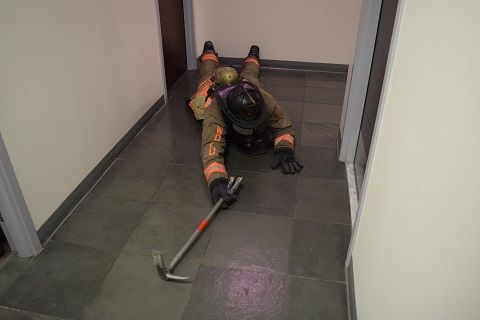
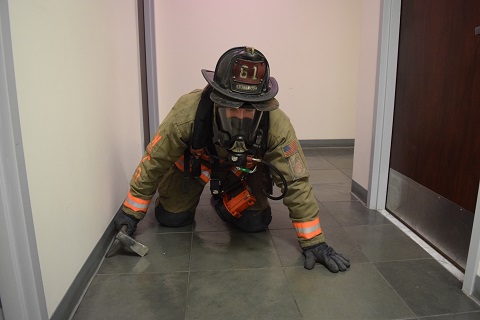
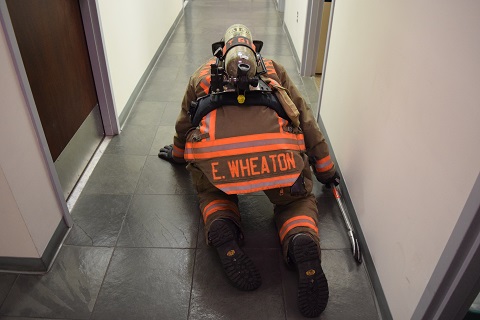
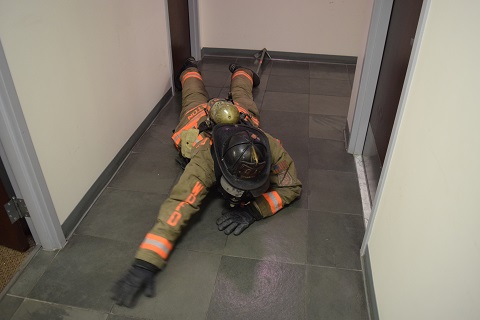
Lets start off with discussing which hand you carry the tool in when you search. for this method it is best to carry the tool in the hand of the direction of the search pattern. Left hand search pattern = carry tool in left hand, right hand search pattern = carry the tool in your right hand. This places the tool against the wall, and minimizes the desire to swing and sweep into the room with the tool. When the searching firefighter feels the need to “extend” the search and sweep out into the room , the tool is paced against the wall and the firefighter places their foot on the tool.
extenedyourhand1
As you can see from the pictures below, the firefighters reach into the room is the exact same regardless if the foot was on the wall and tool swept into the room or if the tool was placed on the wall and the firefighter stretched out into the room.
extenedyourhand3
extenedyourhand4
Another thing worth mentioning is that simple act of constantly swinging the tool out into the room actually contributes to firefight fatigue. It takes more every to swing the tool back and forth than it would to just crawl with it.
Like everything else in the fire service, there is a time and a place were certain techniques should be used over another. This technique may or may not work well for you, but you will only know that after you take the time to train with it. Just keep in mind, when performing a search, you are looking for a viable human life in a very time sensitive manner. It is our duty to master the skill of the search and be able to complete the search in the most time sensitive (and least fatal way) possible.
In our next post we will build on this concept an show some additional things we should consider when performing this type of search.